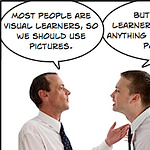
Learning styles: Worth our time?

If you had time to evaluate the research on learning styles, what would you conclude?

Here’s what four cognitive psychologists concluded: “The contrast between the enormous popularity of the learning-styles approach within education and the lack of credible evidence for its utility is, in our opinion, striking and disturbing. If classification of students’ learning styles has practical utility, it remains to be demonstrated.”

Learning styles argumentThat quote is from Learning Styles: Concepts and Evidence, an examination of learning style research. Some more quotes from the paper:

  • Studies are weak: “Although the literature on learning styles is enormous, very few studies have even used an experimental methodology capable of testing the validity of learning styles applied to education. Moreover, of those that did use an appropriate method, several found results that flatly contradict the popular meshing hypothesis.” “Meshing” refers to changing your teaching style to match a learning style. (p. 105)
  • [Read more...]

Do we really need narration?

When should elearning be narrated? I think we should rephrase the question as, “When is it a good idea to force all learners to go at the same pace?”

Man with fingers in earsThat’s what narrated material does. The pace of the narration controls the pace of the material. When you’re learning from narrated material, you can’t easily skim stuff you already know, or slow down and concentrate on the challenging parts, because the voice continues relentlessly at a pace that someone else established.

New studies suggest that learner control + text works better

According to recommendations in books like Elearning and the Science of Instruction, we shouldn’t narrate text that’s displayed on the screen. The redundancy interferes with learners’ ability to digest what they’re being fed. So is it okay to remove the text and use narration alone?

Apparently it is if you’re presenting very short science lessons that are based on graphics, which is what was done in the studies that are often cited. Most of the lessons were no more than 5 minutes long, and the learners couldn’t control the pacing. Those studies suggested that in those situations it’s better to use narration rather than text to explain a graphic.

But what happens if you use narration in material that takes a lot longer to learn, such as an hour? In one study, students who read silent text at their own pace finished more quickly and scored better on both retention and transfer tests than did students who used a narrated version of the materials. [Read more...]

Get a daily instructional design idea

I’ve been tweeting a daily idea to spark your instructional design creativity. To get your daily ID idea, follow me on Twitter. (I don’t say much!)

Some recent tweets in the series:

  • Ask your SME, “What are the 3 most common mistakes people make?” Turn them into branching scenarios.
  • Using a story? What challenge is your character facing? Make them suffer!
  • Are you solving a performance problem, or are you just turning information into a course?
  • What are you creating to support your course? Job aids? Guidance for managers? Follow-up discussion? Additional tips in emails?
  • Teaching a complex procedure? Course: How to use the job aids. Job aids: Everything else.
  • What compelling scenario can you use to start your course? P.S. “A new employee is wondering…” isn’t compelling.
  • Have your learners finish an almost-completed problem, then take away support in stages until they’re flying solo.
  • What do you really want? “Describe the Heimlich maneuver” or “Save lives?” Don’t stop at declarative knowledge.
  • How can you turn a dos/don’ts list into something more memorable? Try short scenarios that show the results; have learners draw the conclusion.

I use the #IDideas hashtag, and other people sometimes chime in with their own ideas. You can see past ideas here.

Image © iStockPhoto: mattjeacock

Why you need to set limits

What happens if you don’t set any boundaries in your relationships? You wear yourself out doing everything for everybody and the next thing you know, you’ve cursed everyone out, grabbed a couple of beers, and slid down the escape chute.

The same thing can happen to your course. If you don’t set any boundaries and try to cover everything for everybody, you end up with a stressed-out course that can’t do anything for anybody.

Just say no

It’s fun to say “no.” Try it!

  • “I’m sorry, but we can’t teach novices and experts simultaneously. We need to pick one or the other.”
     
  • “Let’s focus on people who need to do X in situation Y. If we try to reach ‘everyone who’s interested in X,’ we’ll just create an information dump.”
     
  • “Since widget sniffers and widget snarfers have very different jobs, we should create a separate module for each role.”

No one wants a lukewarm experience

An entrepreneur was convinced he had a great idea. “Some people like hot tea, and other people like cold tea,” he said. “Let’s sell lukewarm tea and dominate both markets!”

Is your course lukewarm?

Image © iStockPhoto: BijoyVerghese

Free Action Mapping webinar on Wednesday

This Wednesday (July 21), I’ll give an online workshop on action mapping, thanks to the Los Angeles chapter of ASTD. The one-hour session starts at 10 AM PST (convert to your time zone). Register here.

We’ll apply action mapping to a compliance training example and discuss how it helps with other types of materials as well. You’ll see how the approach can help you:

  • Pinpoint the business improvement that your materials will help create
  • Identify what people need to do in the real world to create that improvement
  • Brainstorm compelling online activities that help people practice those real-world actions
  • Identify what information should go into the course, what should go into job aids, and what should be cut

This workshop covers the same instructional design approach as the Baton Rouge workshop that you can see here, but we’ll use a compliance example and put more emphasis on tying job aids to the course.

In these workshops I ask for lots of ideas, so come prepared to join the chat!

How to design action-packed elearning

Need to design lean, lively elearning? You might get ideas from this recording of a webinar that I gave today for the Baton Rouge ASTD.

It’s about 45 minutes long and shows how to use action mapping to quickly identify which content and activities will be most useful.

Information dump leads to cognitive overloadThe webinar shows how to:

  • Choose a goal that leads to a measurable business improvement
  • Brainstorm realistic activities that help learners apply their new knowledge on the job
  • Identify what content really needs to be included—and what can be cut
  • Decide what should information should go in a course and what should go in a job aid

You can also download a PDF of the slides, but they don’t make a lot of sense on their own.

I’ll publicize future webinars in this blog and through my Twitter account. I didn’t announce this one because it was my first time flying solo as both a presenter and moderator in Elluminate.

How to design elearning that’s memorable and budget-friendly

Need to make an impact on a budget? You might find some ideas in this presentation.

It shows five decisions you can make that will help you save money and create more memorable elearning. It’s split into five short videos for easy idea-snacking and to meet the restrictions of YouTube.

Highlights include a matrix that helps you decide if training will solve the problem (part 2) and an example of a storyboard that emphasizes activities, not information (part 5).

Here’s the first part.

These links go to YouTube:

Part 1

  • Super-quick overview of action mapping
  • “Awareness” and “tracking” aren’t good reasons to create a course

Part 2

  • Handy matrix to help you answer, “Why aren’t people doing what we need them to do?”
  • Will a course really solve the problem?
  • Example of a multiple-choice question and feedback that simulate the real world

[Read more...]

The big mistake in elearning

Here’s a short presentation that includes:

  • The one powerful change that will make our elearning a lot more effective
  • A quick demo of action mapping
  • A fun example of the type of information that should go in job aids
  • How to get people to stop telling you, “Turn this information into a course”

To see a bigger version on YouTube, click the movie when it’s playing. Can’t access YouTube? Here’s a Flash version.

To practice steering your client away from an information dump, you might try this challenge. [Read more...]

Elearning example: Branching scenario

You’re a US Army sergeant in Afghanistan. Can you help a young lieutenant overcome cultural differences and make a good impression on a Pashtun leader?

That’s the challenge behind “Connect with Haji Kamal,” a decision-making scenario that my cool client Kinection and I developed for the US Army. The online scenario is the homework part of a lesson plan that includes in-class discussion about how to build rapport across cultures. It’s part of a much larger effort in the Army to strengthen soldiers’ cross-cultural and peacekeeping skills.

Turn on your speakers and give it a spin, and then come back here if you’re interested in the design decisions behind the activity.

Connect with Haji Kamal

The goals

The activity is designed to be completed as homework before a culture class, and it includes a facilitator guide with debrief questions. Our goals were to model specific rapport-building behaviors and inspire class discussion.

To follow the “good” paths, you need to see things from Haji Kamal’s point of view, show respect and patience, and otherwise apply cross-cultural skills that will be discussed in class. You end up on less successful branches by making more ethnocentric choices. [Read more...]

Get new ideas from these seminars

Online

April 19: Patrick Dunn and I will take a fresh look at instructional design with Clive Shepherd at 12 noon UK time (convert to your time). “Both Cathy and Patrick are outspoken critics of mainstream e-learning content design and are leading champions in the movement for more creative and engaging solutions.” Join the revolution! Sponsored by the UK eLearning Network and ALT.

On site

London, May 14: Value for money elearning solutions, Holborn Bars. My message: It’s the design, not the technology. Appropriately, I’ll be participating online. Organized by the UK eLearning Network.

More to come

In the next few months, I’ll be giving Action Mapping virtual workshops for some ASTD chapters. I’ll post details as they’re available. And if you want a hands-on workshop of your own, consider setting up a custom seminar.