Go to the Making Change home page

Less text, more learning

Posted in Instructional design, Writing tips by Cathy Moore on 26 January 2009

Do stakeholders want to add text to your materials? Here’s one study you can use to show how wordiness can hurt learning.

The study compared three lessons about the same weather process. All lessons used the same illustrations but varied in the number of words.

The lesson with the fewest words resulted in the most learning.

Bar graph

Read the original publication (PDF) from the Journal of Educational Psychology, or see the summary on pp. 109-115 of Efficiency in Learning by Ruth Clark, Frank Nguyen, and John Sweller.

Why you do not want to sound like a robot

Posted in Human interest, Motivation, Writing tips by Cathy Moore on 19 January 2009

Robot“We shouldn’t use contractions because then people won’t take the content seriously.” Sound familiar?

Or maybe you’ve heard this: “We shouldn’t use contractions because they’re confusing for people who speak English as a second language.”

The result of these beliefs can be robotic chanting like the paragraph that you are reading now. I will not use contractions as I say that sometimes we become obsessed with details of grammar that are not actually useful, and as a result of this obsession we do not see the big picture. We are too busy enforcing small rules that do not help the learner, so we do not realize that our learner is thinking, “I will leave this course now because this text I am reading did not come from a human being.”

“They won’t take it seriously!”

Here’s what Ruth Clark and Richard Mayer have to say about “conversational” style in e-Learning and the Science of Instruction: (more…)

Too basic? Chop it!

Posted in Instructional design, Motivation, Writing tips by Cathy Moore on 15 October 2008

How to get everyone to write like Ernest Hemingway

Posted in Human interest, Motivation, Writing tips by Cathy Moore on 7 October 2008

Probably everyone on your team agrees that elearning should be concise and lively. But does everyone agree on what “concise and lively” looks like? Here’s one way to get everyone on the same stylistic page.

Quantify, quantify

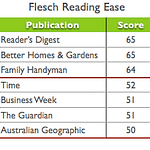
When we talk about writing style, we can get bogged down in personal preferences that are hard to communicate. But if we use readability statistics to quantify style, it’s easier to guide writers.

I’m not talking about the nearly useless “ninth-grade reading level” requirement in your corporate style guide. Instead, let’s look at the Reading Ease measurement that’s part of Word’s readability check. It’s a much more practical guide, especially if you compare your score with that of familiar publications.

Reading ease scores of several publications

What does this chart tell us? (more…)

Can your learners wing it?

Posted in Instructional design, Motivation, Writing tips by Cathy Moore on 31 July 2008

Musicians at a jamYou’re standing in the Daniel Boone National Forest wearing 97 chiggers and a banjo. You’re surrounded by old-time musicians, and they’re playing this tune:

Audio clip: Adobe Flash Player (version 9 or above) is required to play this audio clip. Download the latest version here. You also need to have JavaScript enabled in your browser.

(“Natchez Under the Hill” as played by The Fatted Calf String Band)

You want to play along. But you’ve never heard the tune in your life. What do you do?

If you answered, “Pull out my copy of 10,273 American Old-Time Tunes and read from the book,” you would be very, very wrong.

To join the jam, you need to be able to play by ear–you need to be able to wing it. You need to adapt the rules you’ve learned from other old-time tunes to this new situation.

To transfer their learning to their jobs, your learners need to be able to wing it, too. They need to apply the rules they learn from your courses to new situations that you could never foresee.

Unfortunately, it’s hard to teach people to wing it. It’s easiest to just tell them what to do, but what we need to do is to teach them how to think.

What’s wrong with telling them what to do? (more…)

Dude or droid: What makes dialog realistic?

Posted in Human interest, Tools, Writing tips by Cathy Moore on 16 April 2008

How good is your ear for dialog? Find out with Dude or Droid, a simple drag-and-drop activity I created to try out Dragster.

As you decide who said each blurb, notice the cues that you’re responding to. What makes dialog sound natural, and what makes it sound stiff?

Click the image to start the activity, and pretend the “TRIAL” watermark isn’t there. Then come back here for some dialog tips and a mini-review of Dragster.

Dude or droid: What makes dialog realistic?

What did you notice about the dialog?

In the droid’s lines, you probably saw these symptoms of unnatural dialog: (more…)

Which verb will keep your learners’ interest?

Posted in Writing tips by Cathy Moore on 10 April 2008

Click the green arrow to help determine the next celebrity verb!

How to fit the entire world in a multiple-choice question

Posted in Elearning makeovers, Instructional design, Writing tips by Cathy Moore on 21 March 2008

Makeover logoCan’t afford a full-fledged simulation? You can still recreate the learner’s world in your materials, even if your only tool is the lowly multiple-choice question.

Let’s say you’re writing materials for people who create custom pet hedgehogs using genetic engineering. You might be tempted to write a question like the one below.

Before

It’s a good idea to include parrot genes in a custom hedgehog.

  1. True
  2. False (correct)

How could you make this question more realistically reflect the learner’s world?

First ask yourself, “Why does the learner need to know this fact?”

Then write a question that tests both the learner’s knowledge of the fact and their ability to apply it in the real world. “What if…” questions come in handy for this.

After label (more…)

How to recognize elearning bloat

Posted in Elearning makeovers, Writing tips by Cathy Moore on 10 March 2008

When stakeholders think every detail is equally important, the result can be bloated elearning.

This hilarious YouTube video shows what I mean.

To fight the enemy, we have to see it

My favorite writing teacher used parody to help us recognize and remove bloat. Here’s a small example.

The following statement is sort of Apple style–minimal and direct. Your assignment is to rewrite it, packing in as many words and details as possible.

Before

Don’t bring your cat to work, because some of your colleagues could be allergic.

After label

Here’s one possible rewrite: (more…)

5 ways to make linear navigation more interesting

Posted in Instructional design, Writing tips by Cathy Moore on 28 February 2008

This slideshow is an attempt to help people make the best of a limiting design. Regular readers know that I’m no fan of the Next button. (Are you new here? Try Why you really want to be short or Visual menus: Structure with style).

Thanks to Erik Wallen–his comment on Is a course really the answer? inspired this slideshow.

What did I leave out? What are your favorite ways to liven up linear learning?

(You can download a PDF of the slide show here.)

Next page »