Less text, more learning
Do stakeholders want to add text to your materials? Here’s one study you can use to show how wordiness can hurt learning.
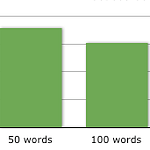
The study compared three lessons about the same weather process. All lessons used the same illustrations but varied in the number of words.
The lesson with the fewest words resulted in the most learning.
Read the original publication (PDF) from the Journal of Educational Psychology, or see the summary on pp. 109-115 of Efficiency in Learning by Ruth Clark, Frank Nguyen, and John Sweller.
Action Mapping goes to Florida and Europe
Orlando, Florida, March 9: Learn “How to Build Courses that Get Results” in my session at the Articulate Live ‘09 user conference. We’ll use Action Mapping to turn a boring information dump into lean, lively elearning.
You’ll also get lots of practical advice from other presenters, including Cliff Atkinson, Ray Jimenez, Tom Kuhlmann, Patti Shank, and expert Articulate users.
The conference is at the same site as the eLearning Guild Annual Gathering. Register by January 23 and you’ll have the chance to win a cool prize.
Europe, late April-early May: Host an Action Mapping seminar of your very own and get hands-on practice creating focused, memorable elearning. I’ll be near Dortmund, Germany, on May 1-3, and am available before and after those dates to give you customized training or to present at an association event. Please contact me for details.
Why you do not want to sound like a robot
“We shouldn’t use contractions because then people won’t take the content seriously.” Sound familiar?
Or maybe you’ve heard this: “We shouldn’t use contractions because they’re confusing for people who speak English as a second language.”
The result of these beliefs can be robotic chanting like the paragraph that you are reading now. I will not use contractions as I say that sometimes we become obsessed with details of grammar that are not actually useful, and as a result of this obsession we do not see the big picture. We are too busy enforcing small rules that do not help the learner, so we do not realize that our learner is thinking, “I will leave this course now because this text I am reading did not come from a human being.”
“They won’t take it seriously!”
Here’s what Ruth Clark and Richard Mayer have to say about “conversational” style in e-Learning and the Science of Instruction: (more…)
Who ARE these people?
How well do you know your learners?
When I write, I try to think of a specific learner, so I can imagine how engaged or confused they might be as they use the material. The problem is, I usually don’t know anyone in the audience.
I hope you’re not so removed from your audience. And if your organization has some sort of discussion forum or blogs, you can get a lot closer to your learners by stealing the “Seven things you don’t know about me” meme that periodically moves through the blogosphere.
I’ve been tagged by Rupa to share seven things. I’m going to trim it down to three for my example: (more…)