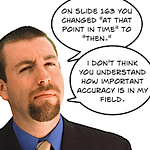
How to convert the toughest SME

You want to create an action-packed online experience that revolutionizes learners’ behavior. Your subject matter expert wants you to faithfully reproduce every lovingly polished bullet of their 217-slide PowerPoint presentation. Is there any hope for your relationship?

Everyone knows that in any relationship, it’s the other person who needs to change. So let’s change your SME.

1. Read what they gave you.

Before you do anything else, read all 217 slides. Respect the effort that the SME has put into their work and try to understand what they wrote. And make a note for future projects: Don’t let SMEs create PowerPoints. Ask them for an informal brain dump instead, or an interview, or any other format that they won’t put so much work into.

2. Involve them from the beginning

If you use Action Mapping, include the SME in the very first discussions with your client, when you identify the goal. Ask the SME to help answer these questions: [Read more...]

How the IRS learned to find you online

When employees of the US Internal Revenue Service need to find out what taxpayers are doing, they look online. How would you train them to dig deep into the web without violating privacy laws?

David Anderson has linked to the script of an online course that the IRS uses to train its employees. It was released during a Freedom of Information Act case and posted by the Electronic Frontier Foundation (EFF). As David points out, the script uses the common tell-then-test approach.

What could they have done differently?

Here’s the script, thanks to the EFF. You’ll see that it’s clearly written and organized, which is great.

Like most elearning, it presents a lot of information and then quickly tests our understanding of that info. It also uses some interesting examples from real life.

The course is a perfectly capable information presentation. But since my tax dollars helped pay for it, I can’t help wishing they had done it differently. So let’s give the IRS some friendly suggestions.

What would happen if we changed the objectives?

The IRS course has these objectives: [Read more...]

Prove it with a prototype

Are you dreaming of an immersive simulation while your team members plan yet another Jeopardy game? If you want stakeholders to expand their horizons, a working prototype is your best friend.

A working prototype has simple placeholder graphics, but the clicking and dragging work as they will in the final activity. Build a quick-and-dirty version of the activity of your dreams, and use it to convert everyone on your team.

Here’s a two-part video that shows what I mean. Leif Cederblom of SmartBuilder compares two prototypes of the same activity and highlights the goals and benefits of prototyping.

Part 1: The conventional drag-and-drop: busywork that’s easy to forget

Part 2: A more realistic activity that’s more likely to change behavior

Try both prototypes yourself and see how the contrast between the two underscores the power of the more realistic activity. No amount of polish would make the drag-and-drop more than a rote activity, while the “leave the lab” prototype is effective even in its raw, prototype form.