Learn more about the action mapping process described in this interaction from this quick overview.
How I designed and built the scenario
Some people avoid creating branching scenarios because they seem too complex. In case it’s helpful, here’s the approach I took.
I kept track of the branching by writing the dialog and results in an informal flowchart. I used OmniGraffle for the flowchart, but you could use any tool that builds basic flow charts or just draw one by hand. Click the image to see a larger version.
As I built the slides, I wrote the slide number by each node of the flowchart for future reference. Then I tested the interaction by following each branch of the flowchart, marking the path with a crayon so I could see at a glance which paths had been checked.
The images of Allison used in the activity come from one of several sets of stock photos designed for use in scenarios, available from ElearningArt.
The “order taker” meter is a static PNG in three versions (“order taker,” midpoint, and “instructional designer”). The learner’s path determines which of these graphics is displayed, just as the path determines which slide is displayed. There are no variables involved.
The scenario in this post is about as long as I’d want to build using a presentation tool like Keynote or PowerPoint. For longer or more complex branching, I’d look at a tool like SmartBuilder, which would let me put multiple results on one “slide” and would display a flowchart of the interaction.
Scenario design toolkit now available
Design challenging scenarios your learners love
Get the insight you need from the subject matter expert
Create mini-scenarios and branching scenarios for any format (live or elearning)
It's not just another course!
Self-paced toolkit, no scheduling hassles
Interactive decision tools you'll use on your job
Far more in depth than a live course -- let's really geek out on scenarios!
Use it to make decisions for any project, with lifetime access
14 comments on “How to steer your client away from an information dump”
Comments are closed.
Probably a minor point, but I think it’s effective that you don’t make the navigation too explicit. After the first couple of screens, sentient adults can figure out whether they need to respond to a question or move on to the next interaction.
I also think your planning (the flowchart) is a real productivity tool: get the logic right — the design, the interactions, the flow — even if you’re using Post-Its on a wall. Only then worry about the actual “screens.”
Dave, thanks for your comment. Post-Its on a wall are a fun way to design a branching scenario, especially if you’re doing it as a team. When I do that, I take a picture of the Post-Its (or whiteboard or whatever) and then refer to the picture when I’m at the computer, zooming in as necessary. Another excuse to get an iPhone!
For creating a flow and develop it to a script, I recommend using a mind mapping tool, e.g:
Anders, thanks for that link. I hadn’t heard of that program before.
No love for Canberra? Might have to chat to our Framework people about that one.
I set out to avoid using flowcharts or mindmaps for scenarios simply because above a certain level of complexity, they confuse me rather than clarify! My procedure is
1) sit with the SME and work out the scene, the characters, the destination, the learning points and the common mistakes; also, sometimes, an unexpected event to drop in in the middle
2) I build the scenario screen by screen in Quandary (http://www.halfbakedsoftware.com/quandary_download.php) starting with the ‘best’ route through, till we get to the end; I aim to reach a satisfactory conclusion in about 12 screens
3) we go back to screen 1 and add two or three alternatives, and the new screens (starting in this example at 13) that they would go to. Some of these will go further, to new screens, some will return to the main narrative
4) although Quandary does output a working HTML scenario I don’t like the look, so I use its print facility to output the scenario to a Word doc, which is used for signoff
5) I then code the scenario in an HTML/Javascript template of my own making; this allows things like capturing whether the user performs certain key actions, and changing the text on some pages depending on whether they’ve done something earlier
I’ve used this quite a few times now with different SMEs; typically it takes 3 hours in the meeting to get to step 4) and about two to three hours to do step (5)
Col: I’m also based out of Canberra so good luck talking to the framework people!!
In your opening, along a graphic you write, “Uncover a concrete, measurable course goal that benefits the business.” I am quite often presented with scenarios to be rewritten, with predetermined goals.
This makes me an order taker. What would you suggest to move me from this status to a responsible IDer?
Norman, thanks for describing your process and for the link to Quandary! I agree with you that the SME is vital to writing a believable scenario, especially if they’re someone who still does the job that’s being described.
Sandee, thanks for your question. One way to find a strong goal is to gently ask why you’ve been asked to rewrite the scenario and also ask for more direct contact with the client or learners.
Why does the scenario need to be rewritten? Has it been used in training and found to have no effect? That could be a sign that the training isn’t focused on a strong goal.
Or is the scenario just considered “boring” by someone on the team, and you’re supposed to “liven it up?” (I get this a lot.)
Either way, it’s completely acceptable and reasonable for you as an ID to ask for more direct contact with the client or stakeholders. Once you have that contact, you can ask questions like those in the Flash scenario.
Politically, it helps if you can phrase your questions as, “I need some more information to make sure the scenario really reflects what would happen on the job, since it’s not a job that I do myself.” If the scenario includes lots of dialog, an additional angle is to say, “I want to make sure I realistically capture how people who do this job talk among themselves, so I need to talk with someone in the job or, ideally, shadow them a bit while they work.”
Both of these approaches are completely reasonable requests that will only improve the scenario. Basically, you’re asking for more direct access to the people affected by the training, so you can find the stronger goal for yourself. Politically, you may need to leave the original goal intact, but you can write the scenario in such a way that it supports the stronger business goal that you’ve uncovered.
Some questions that have worked for me:
– Who has requested this training? Can I talk directly to them? (You could phrase this as, “I could write a more compelling scenario if I could talk directly to the person who has requested it, so I can capture the terminology people in that area use and the perspective they have.”)
– Have there been incidents that inspired this training? What happened? (This gives you creative fodder for the scenario, which you’ll probably have to heavily disguise, and helps you see the business reasons for the training.)
– Can I sit in on a meeting or otherwise shadow people affected by the training? (This is most likely to work if you phrase it as a need to hear how they talk and interact, so you can write realistic dialog and create believable characters.)
– How does this scenario fit into the rest of the materials? (If they’re asking you to rewrite just part of the training content, you can say that you need to be familiar with the whole package to make sure the scenario supports it. Sometimes the larger context can help you identify what the underlying business goal is likely to be.)
If for some (unreasonable!) reason you’re denied access to the people who have requested the training and aren’t allowed to talk to the people who will use it, you could do a little research on your own to see what the business goal could be, based on news about the client and about the issue addressed in the training.
You could quickly search for business news about the client and their competitors, and search for the issue in general terms (like “change management pharmaceutical industry”). I do this kind of research for every new client and most courses.
This is a distressingly common problem. Too often, instructional design is seen as just information design, and IDs are expected to just fix up content that someone else has decided must be presented. To change this, we need to gently but persistently show our clients that we’re performance consultants, not just information presenters, and to do that we need to ask lots of questions.
One of the best software apps I’ve used for branching is Articulate. Initially developed presentations in PPT, Articulate allows you to branch and reorder your slides specific to the users choices.
I like to think of it as a “choose your own mystery” type of situation. It has been successful as an assessment in that you can set up a scenario in Engage and build a different path for each answer…often there can be more than one right answer, so it’s a great way to look at the consequences without real world repercussions.
The point of organizing your branches carefully is important. If you start organizing in the beginning, it will be a much simplier and less daunting task when it comes time to connect everything together in the end.
This type of branching also works when you are speaking to a broad audience. The general topic may apply to everyone, but the individual tasks may apply to only a group of people. Articulate allows for branching to connect people to information that only applies to them.
Certainly an important topic to discuss as ID’s try to make training more engaging and meaningful to the learner.
Hi Cathy, seems this doesn’t work anymore, at least not on my Mac. Anything you can do?
Hi Clive, I’m sorry you’re having trouble with the Flash. I plan to convert this to HTML5 soon but am not sure when exactly “soon” will happen. In the meantime, if you’re using Chrome, you might try a different browser for this page. This interaction is working for me on my Mac in Firefox and Safari, but I’ve heard that some folks with Chrome have trouble.
Clive, I’ve replaced the problematic Flash embed with an HTML5 version, so hopefully the interaction is working for you now.

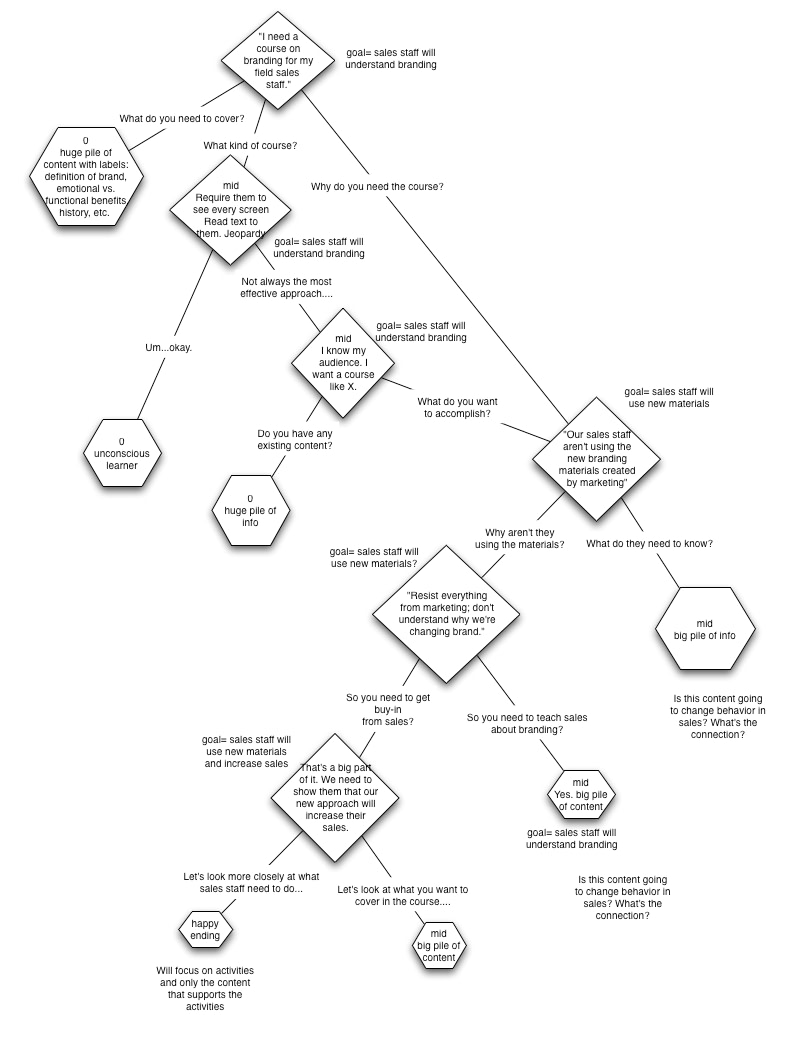 I kept track of the branching by writing the dialog and results in an informal flowchart. I used OmniGraffle for the flowchart, but you could use any tool that builds basic flow charts or just draw one by hand. Click the image to see a larger version.


Probably a minor point, but I think it’s effective that you don’t make the navigation too explicit. After the first couple of screens, sentient adults can figure out whether they need to respond to a question or move on to the next interaction.
I also think your planning (the flowchart) is a real productivity tool: get the logic right — the design, the interactions, the flow — even if you’re using Post-Its on a wall. Only then worry about the actual “screens.”
Dave, thanks for your comment. Post-Its on a wall are a fun way to design a branching scenario, especially if you’re doing it as a team. When I do that, I take a picture of the Post-Its (or whiteboard or whatever) and then refer to the picture when I’m at the computer, zooming in as necessary. Another excuse to get an iPhone!
For creating a flow and develop it to a script, I recommend using a mind mapping tool, e.g:
http://www.scriptmapping.com/
Anders, thanks for that link. I hadn’t heard of that program before.
No love for Canberra? Might have to chat to our Framework people about that one.
I set out to avoid using flowcharts or mindmaps for scenarios simply because above a certain level of complexity, they confuse me rather than clarify! My procedure is
1) sit with the SME and work out the scene, the characters, the destination, the learning points and the common mistakes; also, sometimes, an unexpected event to drop in in the middle
2) I build the scenario screen by screen in Quandary (http://www.halfbakedsoftware.com/quandary_download.php) starting with the ‘best’ route through, till we get to the end; I aim to reach a satisfactory conclusion in about 12 screens
3) we go back to screen 1 and add two or three alternatives, and the new screens (starting in this example at 13) that they would go to. Some of these will go further, to new screens, some will return to the main narrative
4) although Quandary does output a working HTML scenario I don’t like the look, so I use its print facility to output the scenario to a Word doc, which is used for signoff
5) I then code the scenario in an HTML/Javascript template of my own making; this allows things like capturing whether the user performs certain key actions, and changing the text on some pages depending on whether they’ve done something earlier
I’ve used this quite a few times now with different SMEs; typically it takes 3 hours in the meeting to get to step 4) and about two to three hours to do step (5)
Col: I’m also based out of Canberra so good luck talking to the framework people!!
In your opening, along a graphic you write, “Uncover a concrete, measurable course goal that benefits the business.” I am quite often presented with scenarios to be rewritten, with predetermined goals.
This makes me an order taker. What would you suggest to move me from this status to a responsible IDer?
Norman, thanks for describing your process and for the link to Quandary! I agree with you that the SME is vital to writing a believable scenario, especially if they’re someone who still does the job that’s being described.
Sandee, thanks for your question. One way to find a strong goal is to gently ask why you’ve been asked to rewrite the scenario and also ask for more direct contact with the client or learners.
Why does the scenario need to be rewritten? Has it been used in training and found to have no effect? That could be a sign that the training isn’t focused on a strong goal.
Or is the scenario just considered “boring” by someone on the team, and you’re supposed to “liven it up?” (I get this a lot.)
Either way, it’s completely acceptable and reasonable for you as an ID to ask for more direct contact with the client or stakeholders. Once you have that contact, you can ask questions like those in the Flash scenario.
Politically, it helps if you can phrase your questions as, “I need some more information to make sure the scenario really reflects what would happen on the job, since it’s not a job that I do myself.” If the scenario includes lots of dialog, an additional angle is to say, “I want to make sure I realistically capture how people who do this job talk among themselves, so I need to talk with someone in the job or, ideally, shadow them a bit while they work.”
Both of these approaches are completely reasonable requests that will only improve the scenario. Basically, you’re asking for more direct access to the people affected by the training, so you can find the stronger goal for yourself. Politically, you may need to leave the original goal intact, but you can write the scenario in such a way that it supports the stronger business goal that you’ve uncovered.
Some questions that have worked for me:
– Who has requested this training? Can I talk directly to them? (You could phrase this as, “I could write a more compelling scenario if I could talk directly to the person who has requested it, so I can capture the terminology people in that area use and the perspective they have.”)
– Have there been incidents that inspired this training? What happened? (This gives you creative fodder for the scenario, which you’ll probably have to heavily disguise, and helps you see the business reasons for the training.)
– Can I sit in on a meeting or otherwise shadow people affected by the training? (This is most likely to work if you phrase it as a need to hear how they talk and interact, so you can write realistic dialog and create believable characters.)
– How does this scenario fit into the rest of the materials? (If they’re asking you to rewrite just part of the training content, you can say that you need to be familiar with the whole package to make sure the scenario supports it. Sometimes the larger context can help you identify what the underlying business goal is likely to be.)
If for some (unreasonable!) reason you’re denied access to the people who have requested the training and aren’t allowed to talk to the people who will use it, you could do a little research on your own to see what the business goal could be, based on news about the client and about the issue addressed in the training.
You could quickly search for business news about the client and their competitors, and search for the issue in general terms (like “change management pharmaceutical industry”). I do this kind of research for every new client and most courses.
This is a distressingly common problem. Too often, instructional design is seen as just information design, and IDs are expected to just fix up content that someone else has decided must be presented. To change this, we need to gently but persistently show our clients that we’re performance consultants, not just information presenters, and to do that we need to ask lots of questions.
One of the best software apps I’ve used for branching is Articulate. Initially developed presentations in PPT, Articulate allows you to branch and reorder your slides specific to the users choices.
I like to think of it as a “choose your own mystery” type of situation. It has been successful as an assessment in that you can set up a scenario in Engage and build a different path for each answer…often there can be more than one right answer, so it’s a great way to look at the consequences without real world repercussions.
The point of organizing your branches carefully is important. If you start organizing in the beginning, it will be a much simplier and less daunting task when it comes time to connect everything together in the end.
This type of branching also works when you are speaking to a broad audience. The general topic may apply to everyone, but the individual tasks may apply to only a group of people. Articulate allows for branching to connect people to information that only applies to them.
Certainly an important topic to discuss as ID’s try to make training more engaging and meaningful to the learner.
Hi Cathy, seems this doesn’t work anymore, at least not on my Mac. Anything you can do?
Hi Clive, I’m sorry you’re having trouble with the Flash. I plan to convert this to HTML5 soon but am not sure when exactly “soon” will happen. In the meantime, if you’re using Chrome, you might try a different browser for this page. This interaction is working for me on my Mac in Firefox and Safari, but I’ve heard that some folks with Chrome have trouble.
Clive, I’ve replaced the problematic Flash embed with an HTML5 version, so hopefully the interaction is working for you now.