As I’ve mentioned in Tom Kuhlmann’s newest post, one thing that I’ve learned early on is that the SMEs can get touchy when there is an attempt to rewrite some of the content into manageable or understandable chunks, particularly when they’re the ones who composed it. What always happens is that we have to back down and give in to the wishes of the SME. One explanation for retaining the very verbose content is that “if the learners do not get this, then they don’t deserve to pass”.
Good grief.
Thanks for the comments. Zelanne, one way to deal with SMEs like that is to interview them instead of letting them write anything. When we write something, it’s natural to feel ownership of it. If someone else writes it and then gives it to us for review, we’ll “correct” them, but we’re unlikely to completely rewrite everything they did.
I think there’s often a political problem as well. If training folks are seen as people who just “put information online,” then SMEs and others are going to call the shots. If we can instead be seen as adding value with instructional design, then we have more say. That can be a big change for a lot of organizations.
Emma, I agree with Eric about chunks. If it could stand alone as a mini-activity, it’s a useful chunk.
Another way to deal with the easy and advanced stuff is with branching. You could aim your main materials at the middle ground–what everyone absolutely has to know to perform the behaviors that the elearning is trying to achieve. Then you could give learners the option to also see basic info (like “What is a widget?” which links to a section about widgets) or advanced info (“Tell me more about widget alignment,” which links to more details).
You can do this in PowerPoint and probably most conversion software by hyperlinking to a specific optional slide, then linking that slide back to the main path.
It might also help to get everyone on the same page by showing them the Action Mapping slideshow and including them when you’re figuring out the activities. Then they’ll see what info will be absolutely necessary and will be (ideally) more likely to understand when their favorite “History of Widgets” gets cut.
It’s also difficult, when you’re trying to be concise deciding what should be omitted. Do you omit the “easy” stuff, on the grounds they should know it, or do you omit the “advanced” stuff, on the grounds that only a few need it.
Once you’ve done that – then deciding what the chunks are – does what seems like a good chunk to me actually make sense to someone else?
Emma – for easy stuff, you can be concise by using very few words or by grouping easy stuff with other more challenging lessons. Sort of tack easy stuff on to meatier lessons.
For the advanced, once in a blue moon stuff, skip it! Let the SMEs on the floor get a thrill by teaching that. Of course, get buy in from stakeholders who agree to an “80-20 rule” so they are on board with omitting those advanced (rare) lessons.
Chunks can be an art. 6 designers might chunk the same course differently! Here’s one aim: create chunks that can be used independently, too. If a few objectives fit well into a lesson/chunk and that same chunk could be used as “refresher” or supplemental training later — a quick lesson during a weekly meeting — then you know your chunk is good…you have a solid argument why it should be a chunk.
Easy! Keep it Simple, Short- eKiss
These findings are not surprising. But the issue is not only confined to reducing superfluous text.
The “problem” (if there even is one), is the bland unimaginative producers of elearning. It always comes back to are you a good story teller? Can you engage a group on complex issues and motivate as well as teach?
And when it’s all said and done, most elearning producers are just average. If it were easy to teach, write books, produce movies, then we’d have an endless stream of awesome content. The good news is, that only a relative few are so talented.. And that is as it should be.
mike whatley
altadena, ca
A lifetime of critical reading and concise writing (I’m a lexicographer) has taught me that it is not the number of words that affects learning but instead the number of words that do not contribute to the understanding of the subject. Since neither the correct conveyance nor the correct grasp of a message occurs automatically, the writer’s objective should be to make the writing as clear as possible–no matter how many words it takes, and not a single word more.
It’s empirical evidence that less is more.
Yes.
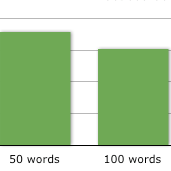
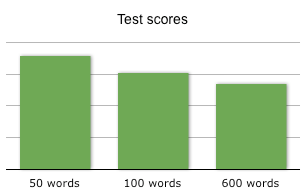
Thanks for the comments. If you’re concerned that deleting words will reduce understanding, please look at the study. The study makes clear that the researchers summarized information–they didn’t randomly delete words. The increase in test scores makes clear that these summaries increased understanding.
There are many other posts on this blog that go into more detail about how writing style can affect understanding and motivation. You can see these posts by clicking the “Writing tips” category.
Even if fewer words result in a lack or absence of understanding? Try chopping-off words at random and see what you get. Empirical evidence doesn’t compel us to suspend critical thinking but instead requires an open mind for the full exploration of the conclusion presented. All evidence, empirical included, yields results on the basis of its interpretation otherwise everything in the world would be have already been decided on the basis of the observed (experiential) phenomenon! As new information becomes available, the same ‘facts’ lead us to different outcomes. For example, before Galileo’s interpretation the empirical fact was that sun orbits the Earth.
Even if fewer words result in a lack or degradation of understanding? Do you mean that as the number of words is reduced there is a corresponding increase in the level of comprehension? Or that a judicial review of a document to weed out the superfluous words and phrases (and maybe even restructuring the written piece) clarifies the subject matter? Empirical evidence doesn’t compel us to suspend critical thinking but instead requires an open mind for the judicial review of the conclusions presented. All evidence, empirical included, yields results on the basis of its interpretation otherwise everything in the world would have already been decided on the basis of the observed (experiential) phenomenon! As new information becomes available, the same ‘facts’ lead us to different outcomes. For example, before Galileo’s interpretation the empirical fact was that sun orbits the Earth.
My apologies for the duplication…I had inadvertently pressed the enter key before I was ready to post.
It is evident I haven’t been able to get my point across. I apologize. As my last post on this matter I only have to say that it is the elimination of words that do not contribute to the understanding of the subject matter that result in better comprehension. There is large amount of literature on this topic and if someone is interested I’ll provide references.
You got your point across Vijay! I found it stimulating and v alid ! It made me re read what you had said twice to grasp it!






Is this why Twitter is getting so popular 🙂
Years after Shakespeare, and “brevity” is still, “the soul of wit.” I’ve had many debates over reducing training. Thanks for this blog post.
I just read the email equivalent at this blog:
http://www.fireandmotionblog.com/2009/01/14/short-emails-get-read/
Best,
Eric
@tweric
As I’ve mentioned in Tom Kuhlmann’s newest post, one thing that I’ve learned early on is that the SMEs can get touchy when there is an attempt to rewrite some of the content into manageable or understandable chunks, particularly when they’re the ones who composed it. What always happens is that we have to back down and give in to the wishes of the SME. One explanation for retaining the very verbose content is that “if the learners do not get this, then they don’t deserve to pass”.
Good grief.
Thanks for the comments. Zelanne, one way to deal with SMEs like that is to interview them instead of letting them write anything. When we write something, it’s natural to feel ownership of it. If someone else writes it and then gives it to us for review, we’ll “correct” them, but we’re unlikely to completely rewrite everything they did.
I think there’s often a political problem as well. If training folks are seen as people who just “put information online,” then SMEs and others are going to call the shots. If we can instead be seen as adding value with instructional design, then we have more say. That can be a big change for a lot of organizations.
Emma, I agree with Eric about chunks. If it could stand alone as a mini-activity, it’s a useful chunk.
Another way to deal with the easy and advanced stuff is with branching. You could aim your main materials at the middle ground–what everyone absolutely has to know to perform the behaviors that the elearning is trying to achieve. Then you could give learners the option to also see basic info (like “What is a widget?” which links to a section about widgets) or advanced info (“Tell me more about widget alignment,” which links to more details).
You can do this in PowerPoint and probably most conversion software by hyperlinking to a specific optional slide, then linking that slide back to the main path.
It might also help to get everyone on the same page by showing them the Action Mapping slideshow and including them when you’re figuring out the activities. Then they’ll see what info will be absolutely necessary and will be (ideally) more likely to understand when their favorite “History of Widgets” gets cut.
It’s also difficult, when you’re trying to be concise deciding what should be omitted. Do you omit the “easy” stuff, on the grounds they should know it, or do you omit the “advanced” stuff, on the grounds that only a few need it.
Once you’ve done that – then deciding what the chunks are – does what seems like a good chunk to me actually make sense to someone else?
Emma – for easy stuff, you can be concise by using very few words or by grouping easy stuff with other more challenging lessons. Sort of tack easy stuff on to meatier lessons.
For the advanced, once in a blue moon stuff, skip it! Let the SMEs on the floor get a thrill by teaching that. Of course, get buy in from stakeholders who agree to an “80-20 rule” so they are on board with omitting those advanced (rare) lessons.
Chunks can be an art. 6 designers might chunk the same course differently! Here’s one aim: create chunks that can be used independently, too. If a few objectives fit well into a lesson/chunk and that same chunk could be used as “refresher” or supplemental training later — a quick lesson during a weekly meeting — then you know your chunk is good…you have a solid argument why it should be a chunk.
Easy! Keep it Simple, Short- eKiss
These findings are not surprising. But the issue is not only confined to reducing superfluous text.
The “problem” (if there even is one), is the bland unimaginative producers of elearning. It always comes back to are you a good story teller? Can you engage a group on complex issues and motivate as well as teach?
And when it’s all said and done, most elearning producers are just average. If it were easy to teach, write books, produce movies, then we’d have an endless stream of awesome content. The good news is, that only a relative few are so talented.. And that is as it should be.
mike whatley
altadena, ca
A lifetime of critical reading and concise writing (I’m a lexicographer) has taught me that it is not the number of words that affects learning but instead the number of words that do not contribute to the understanding of the subject. Since neither the correct conveyance nor the correct grasp of a message occurs automatically, the writer’s objective should be to make the writing as clear as possible–no matter how many words it takes, and not a single word more.
It’s empirical evidence that less is more.
Yes.
Thanks for the comments. If you’re concerned that deleting words will reduce understanding, please look at the study. The study makes clear that the researchers summarized information–they didn’t randomly delete words. The increase in test scores makes clear that these summaries increased understanding.
There are many other posts on this blog that go into more detail about how writing style can affect understanding and motivation. You can see these posts by clicking the “Writing tips” category.
Even if fewer words result in a lack or absence of understanding? Try chopping-off words at random and see what you get. Empirical evidence doesn’t compel us to suspend critical thinking but instead requires an open mind for the full exploration of the conclusion presented. All evidence, empirical included, yields results on the basis of its interpretation otherwise everything in the world would be have already been decided on the basis of the observed (experiential) phenomenon! As new information becomes available, the same ‘facts’ lead us to different outcomes. For example, before Galileo’s interpretation the empirical fact was that sun orbits the Earth.
Even if fewer words result in a lack or degradation of understanding? Do you mean that as the number of words is reduced there is a corresponding increase in the level of comprehension? Or that a judicial review of a document to weed out the superfluous words and phrases (and maybe even restructuring the written piece) clarifies the subject matter? Empirical evidence doesn’t compel us to suspend critical thinking but instead requires an open mind for the judicial review of the conclusions presented. All evidence, empirical included, yields results on the basis of its interpretation otherwise everything in the world would have already been decided on the basis of the observed (experiential) phenomenon! As new information becomes available, the same ‘facts’ lead us to different outcomes. For example, before Galileo’s interpretation the empirical fact was that sun orbits the Earth.
My apologies for the duplication…I had inadvertently pressed the enter key before I was ready to post.
It is evident I haven’t been able to get my point across. I apologize. As my last post on this matter I only have to say that it is the elimination of words that do not contribute to the understanding of the subject matter that result in better comprehension. There is large amount of literature on this topic and if someone is interested I’ll provide references.
You got your point across Vijay! I found it stimulating and v alid ! It made me re read what you had said twice to grasp it!
Thanks for the guidance!
Cheers,
mike whatley
altadena, Ca.